Pages

Showing posts with label The Columbus Dispatch. Show all posts

March 24, 2016

Central Ohio on $750,000

Photo via The Columbus Dispatch
Each month The Columbus Dispatch showcases a variety of homes within the Central Ohio area that fall within the same price range. For February, the Dispatch featured homes with prices close to $750,000. From a condo in Bexley to 20 acres in Mount Vernon, $750,000 can go a long way in Central Ohio. See the full list here.

March 21, 2016

Gas Versus Electric: Which is Better to Heat Your Home?


Record low gas prices – and spiking electricity costs – have many Central Ohioans rethinking the switch from gas to electric heat. Several years ago, many homeowners switched their heating system to electric in an effort to cut down on utility costs. These same homeowners are now finding that gas heating may have been the cheaper choice all along. Read the full article from The Columbus Dispatch here and let us know your thoughts. Do you have gas or electric heat? Which system is better for you and your family?

September 28, 2015

2015 Parade brings changes, but doesn't disappoint


This year's Parade of Homes event may be smaller, and further from Columbus, but offers no shortage of features or fans. The Parade's 2015 location, Northstar Community, near Sunbury, is farther outside of the Columbus area than in previous years. The Parade also features only six homes, each with a price less steep than in years past. The Parade's dates are a change, as well, debuting in fall, rather than the summer.

In spite of all these changes, builders say their homes are selling well, perhaps due to this year's more
affordable prices and realistic floor plans. The homes may be less pricey than in previous years, but
Parade attendees can still expect to see the interesting and up-and-coming designs the Parade is known for.  Non-traditional wall textures, secret grocery doors, and unique furniture pieces can all be found in homes in the 2015 Parade.

Fans of the Parade's unique touches won't be disappointed. In this case, a smaller scale doesn't mean a
lapse in quality.

The Parade of Homes runs from September 19 - October 4.

Based on an article from The Columbus Dispatch.

July 9, 2015

Plan submitted to develop Jacquemin Farms into apartments, shopping center

via jacqueminfarms.com
 
Jacquemin Farms, a popular flower and produce farm on Hyland-Croy Road may soon be converted into a new development containing shops and apartments, the Dispatch reports. Schottenstein Real Estate Group recently submitted plans to develop the property. If the plans are approved, the Jacquemin Family will still continue to operate a small market on the property, but will grow their goods elsewhere. The farm was originally a sod farm, but over time the Jacquemin family converted the property into a popular destination for school trips and family outings.
 
According to The Columbus Dispatch, the Scottenstein Group's submitted plans call for the land to be developed in three parts. The first part, comprised of 36 acres, will be used to build 300 rental units, made up of both apartments and townhomes. The second part, comprised of 11 acres, will be dedicated to a senior assisted-living facility. The third part, comprised of 11.5 acres, will become two retail centers.
 
Although the Schottenstein Group has submitted their plans, the township's zoning board has yet to reach a decision on if the development will occur. The board is said to be considering the traffic impact of such a project, and has put the request on their agenda for their July 27th meeting.

May 6, 2015

Central Ohio Apartment Construction Skyrockets Alongside Rental Rates

The current market in Central Ohio is geared towards renters: last year, for the first time in two decades, more apartments were built than single family homes, at 3,037 and 2,903, respectively, according to The Columbus Dispatch. This stands in stark contrast to 2006 to 2012, during which time the number of apartments built was fewer than 5000, or about 833 a year. Percentage wise, the number of rental households in Central Ohio rose 8.7 percent between 2009 and 2013 while the number of owner-occupied households dropped 9.3 percent, according to the National Association of Realtors. 

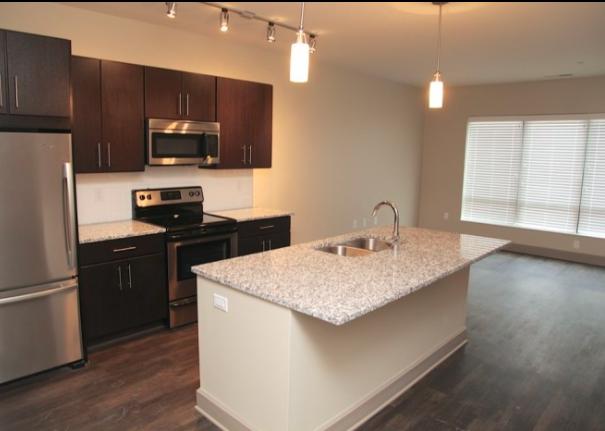
Part of this can be attributed to inadequate finances following the recession; part of it can be attributed it to changing preferences and demographics. Young people are getting married and starting families later in life; so too are they delaying buying their first home. On the other end of the spectrum, there is an increasing rental demand from empty nesters looking for low-mainitence lifestyles. Both cases have resulted in an increased spread of luxury apartment buildings offering things like granite countertops, walk in closets, high ceilings with crown molding, wood floors, and prime locations walking distance to restaurants  bars, shops, and parks. The Short North, Downtown, German Village, Victorian Village, Italian Village, and Brewery District are popular areas. Of course, this all comes at the expense of soaring rental rates. One bedrooms of this sort are rare for less than $1000 and two bedroom units can cost as much as $3000 per month. 


Aston Place is one of many newly constructed apartment complexes in the Short North

As a result, homeowners can find some strong incentives to buy, including historically low interest rates and tax incentives. Not to mention, when you buy a home, you benefit from building equity and property appreciation. You can update or modify your home as you please and don't have to abide by silly rules ("no candles"), and forget paying an extra $30/month for having a pet, and another $80 for parking your car. Use Realtor.com's Rent vs. Buy Calculator to see which option would make more financial sense for you, or contact me to see how I can help. 

Experts expect apartment construction to slow down within the coming year, as the best locations are purchased and developed. 


April 22, 2015

Buckeye Lake's New Dam Puts Summer on Hold

A recent article in The Columbus Dispatch reports that the state will soon replace Buckeye Lake's dam, keeping the reservoir's water level low, which will prohibit boating, for the duration of the project. The estimated $150 million project will take about five years.


While the replaced dam is necessary for structural and safety purposes, the project is concerning for many reasons. Local businesses that depend on seasonal recreation such as the Buckeye Lake Winery, to the left, will likely suffer from decreased business. Many of Buckeye Lake's attractions (including its Yacht Club, above, and restaurants such as Captain Woody's and Papa Boo's) can be reached by boat. The project will also hurt residents, who will not be able to use the lake for the duration of the project or experience the lake view they've grown accustomed to. Not to mention, Buckeye Lake residents who were hoping to sell their home any time soon will be hard-pressed to find a buyer at this time.

Buckeye Lake, renamed from Licking Summit Reservoir, was declared a public park in 1894. How did it end up in this position? In the early 1900s, Ohio's Board of Public Works sold the land excavated to use in building the dam and leased the land occupied by the the backside of the dam for private development. At this time, the area was mostly farmland, as it no longer served as a feeder lake for the Ohio and Erie Canal. Buckeye Lake soared in popularity when an electric interurban railway system began taking vacationers there. Even through the railway went out of business in 1930, Buckeye Lake was in good shape: it had an amusement park (see image below) complete with a beach, arcade, bathhouse, and two dance pavilions.


In the last 1950s, the Chief of Parks V.W. Flickinger declared that the occupied lands by the back half of the Buckeye Lake Dam were "no longer needed for public recreation, parking areas, roads and highways, or other projects of a public nature." This so-called property surplus was subsequently divided into 77 lots in the 1960s, by which time the amusement park was falling into disrepair. A sidewalk along the dam's crest separated private from state property; however, residents paid little attention to this boundary and built patios, decks and docks as they pleased without facing repercussion. While drawings had to be submitted to the parks office for approval, many residents came in with modest drawings and proceeded to build much larger scale projects. Some residents feel that the state is to blame for selling the property rights in the first place, while the states blames the residents for encroaching upon the dam.

Currently, 370 homes sit atop the 4.1 mile dam. Michael Spoor states that Buckeye Lake is "without precedent" in the number of man-made encroachments compromising its structure. Spoor has studied dams for the U.S Army Corps of Engineers for over 40 years. The Corps claims that the man-made impediments are the most significant source of the dam's many defects, and now its current residents will have to pay the price as they wait patiently to get their summers back.

For those interested in owning a house on the water, consider buying a property on Indian Lake (below) in Logan County (Western Ohio). Widely used for recreational activities such as fishing and boating, the  area is also known for its wildlife and walking trails. Check out my current listing on Indian Lake: a two bedroom, two bathroom condo that's furnished and move-in ready! The 2nd level, end-unit condo has a new hot water tank, carpeting, decking, and HVAC. It's eligible for a 0% down USDA home loan, and comes with an assigned boat slip! Contact me to learn more.


March 14, 2014

Interested in Foreclosures? The Privatization of Foreclosure Auctions

Considering buying a foreclosed home? Private auction companies offer an alternative to sheriff sales, which can be inefficient and time consuming. Privatized sales are increasing in Ohio, as lenders experiment with them and are impressed by the results.

How it works: After a judge rules in favor of a bank's foreclosure suit, the lender petitions the sheriff to auction the property. However, the lender can instead ask the judge to appoint a private auction company. This little known state law explains why privatized foreclosures are still rare.

Benefits: Private auctions allow homes to be marketed in conventional ways, i.e., through advertising, open houses, and appearances on real-estate sites fed by the MLS. Potential buyers can see and inspect the inside of the home for themselves. By omitting the bank from the process, private auction sales speed up the process, which is more mainstream. It also allows a homebuyer's agent to earn a commission. Sheriff sales, on the other hand, neither market homes nor offer a commission. They attract few bidders, causing banks to buy back the properties to safeguard their investments.

The Numbers: Barry Baker, founder of Ohio Real Estate Auctions, shared that while 90% of properties auctioned at Ohio sheriff sales had to be bought back by banks, banks have bought back less than 5 percent of the 100+ foreclosed properties that his company has auctioned. Moreover, Baker's company sees many properties that have already, and unsuccessfully, gone through the sheriff-sale process.

Disadvantages: Buyers may have to pay more for a foreclosure auctioned by a private company. The Columbus Dispatch provided one example. A Geauga County property was originally auctioned by the government with bids starting as low as $73,300--with no takers. The property was then given to a company, which marketed it, attracted over 20 bidders, and sold for $170,500--more than twice the original bid in the sheriff sale. While the price for the home mostly increased due to competition resulting from marketing efforts, private auction companies can charge a fee for their services and for the commission to the buyer's agent. Ohio Real Estate Auctions charges a 10% buyers premium to cover such costs. Another debatable disadvantage deals with the fact that a government function is being replaced by a private one. Executive director of the Buckeye State Sheriff's Association Robert Cornwell fears that private auction companies are mainly profit driven, whereas the government works for the people. He is also concerned that sheriffs may be reluctant to give up one of their long-standing duties.

Overall, private auctions market a home conventionally and allow for a quicker, more efficient process that differs much less from non-forclosures than sheriff sales do. For more information on how to buy a foreclosed home, watch the brief video, below.


February 3, 2014

Frist-Time Homebuyers: Are you Ready?

Choosing to purchase your first home is a big decision, and it should be well-infomed. Before you decide to commit, ask yourself the following questions, as posed by an article in The Columbus Dispatch:

1) Are you aware of home ownership expenses? Qualifying for a mortgage and having enough money for a downpayment are huge considerations--but they aren't the only ones. Homeowners also pay property taxes, mortgage insurance, utilities costs, and routine maintenance expenses. And what if you have to buy a new roof or A.C. unit? Certified financial planner Paul Dolce urges buyers to wait until they can put 20% down on a home to avoid mortgage insurance and to "establish a a pattern of financial discipline."

2) Are you willing to sacrifice your weekends? Maintaining a home requires several factors--such as lawn care, garden care, DIY projects such as painting, and home repair. On average, adults spend 3-4.3 hours on lawn/garden work each week, according to a 2009 Bureau of Labor Statistics survey. In other words, owning a home does not only require money--it also requires time.

3) Are you sure you'll want to live in this house for at least five years? You build equity while you live in your home. Thus, the longer you live there, the more financially practical it becomes to buy the home rather than rent it. Roughly, if you plan to live in your home for less than five years, home expenses and buying/selling costs may put you at a  loss. It would be more economical for you to rent.

4) Are you confident your relationships will remain the same? Is there a possibility of divorce in your future? What about marriage? Children? If these scenarios are a part if your relatively near future, you may want to delay buying a home. What home and neighborhood is right for a single person may not be so great for a family with two kids. Often, married couples like to buy homes together, so if you're in a serious long-term relationship, it may be smart to wait a bit longer before you take the plunge into homeownership.

5) What is your backup plan? If something happens to your job, or if you need to finance a new hot water heater or car, it's good to have at least six months of housing expenses saved up. This will act as a cushion and ensure that unforeseen expenses won't threaten your new home and lifestyle.

6) Have you researched the neighborhood? Neighborhoods come with different lifestyles. Is the neighborhood you're considering consistent with your way of life? For example, if you're a family with small children, you'll want to ensure that the neighborhood is family friendly. If you live near many retirees or empty nesters, they may be less forgiving when your kids run through their yards. If you like to entertain, you'll want to know that you can play louder music without bothering other people. Ideally, your neighbors will join in, and the area you live in will have lots of kids who can befriend your own.

If you feel confident with way you answered these questions, then congratulations! You're most likely ready to buy your first home. I specialize in first-time home buyers. Please contact me to discuss your home-buying wants and needs, and to see what I can do for you.


January 30, 2014

Co-Signing a Mortgage? Beware


Jim Weiker, writer for The Columbus Dispatch, warns against the danger of co-signing a mortgage. The co-signer assumes all the risks of the loan but receives none of the benefits. The lender is just as responsible, and this can amount to taking on a second mortgage. A co-signer is responsible for making a payment if the other person defaults. Ask yourself if you can afford that—as many as 3/5 co-signers end up paying the loan as reported by the Federal Trade Commission.

Even worse, some theorize that co-signers are pursued when lenders face delinquent funds. A lender could sue you, especially if you have better credit than the other signee. Thus, it could limit the co-signer’s ability to borrow money him/herself.

Finally, co-signing for a friend or family member could put a strain on your relationship. Would you judge they way someone spent that money that you co-signed for? If you want to financially help someone you care about, consider giving money towards the down payment (up to $13,000/year without paying a gift tax, or $26,000 filing jointly).

So before you co-sign a mortgage, think twice before you agree. Read the full article here.


January 9, 2014

McAlester Publishes 2nd ed. "A Field Guide to American Houses"

A Field Guide to American Houses was published in 1984 by wife and husband Virginia and Lee McAlester. The reference book described different styles of American homes, for example Craftsmans. Nearly 30 years later, Virginia has published the book's second addition, which is 350 pages longer than the original. New sections are included, while previous sections are expanded upon. Some new categories include ranches, split-levels, and millennium mansions. In an interview with The Columbus Dispatch, author Virginia McAlester tells readers they can expect an ebook edition. She also shared her belief that "green construction will dominate American home design and construction for the next generation" by making living both more comfortable and affordable.

The hardcover second edition of A Field Guide to American Houses can be purchased on Amazon.com for $31.63 (prime).


The original Field Guide to American Houses:          The second ed. Field Guide to American Houses:                                        
          
         
Author Virginia Savage McAlester
       

November 11, 2013

Experts 'Okay' Retiring with a Mortgage


According to Jim Weiker’s article in The Columbus Dispatch, experts claim that carrying a home loan into retirement is not all the bad. An increasing number of people are keeping a mortgage longer than a job, and the amount of retirees holding a mortgage has skyrocketed from 26.4% in 1989 to 65.7% in 2012 for homeowners 64+. Likewise, the average mortgage debt held by people between 65 to 74 of age nearly tripled from 25,900 in 1989 to $70,000 in 2010, according to the federal Survey of Consumer Finances. Theories on the topic vary. Some claim that these statistics reflect “people living beyond their means and failing to save for retirement.” Others argue that debt is “simply a fact of life, not something they expect to end.” The survey revealed additional noteworthy statistics: 36% of those surveyed expect their debts to succeed their assets following retirement. Recently low interest rates support peoples’ decisions to purchase home they may be unable to finance. Senior analyst with Bankrate, Greg McBride, mentions that there is no incentive for retirees to pay off their mortgage. Paying off a low-rate, often tax deductible debt is not most people’s top priority (whereas credit card, for example, is).

The bottom line: if you have enough cash flow to support the mortgage payment, it’s perfectly fine to hold a mortgage after you stop working. But if you don’t have the necessary income to support the mortgage during retirement, it’s probably a good idea to sell your home. If you’re in this position, please consider letting me be your real estate agent. I’m very experienced with senior homeowners, and would be glad to help you sell your home. 


October 1, 2013

How to Avoid Buyer's Remorse

Jim Weiker, writer for The Columbus Dispatch, shares some survey results that could provide valuable lessons to buyers. A Trulia survey was issued this spring to 2,130 Americans. Here are the results:

52% of those surveyed expressed some regrets about their current residence
34% wish they had bought a bigger home
27% wish they had done more remodeling
22% wish they had known more about the home before deciding to buy it
18% wish they had put more money down
16% wish they had been more financially secure before buying.

Concerned about buying the right home? Contact me to see how I can help!


August 16, 2013

Student Debt Hindering First-Time Homebuyers


Kenneth Harney wrote for The Columbus Dispatch that student debt is impeding first-time homebuyers. This group traditionally accounted for 40% of home purchases, but only reached 28% in May 2013, according to the National Association of Realtors. The lack of first-time homebuyers creates a domino effect on the housing market: no one is there to buy starter homes, those who currently live in starter homes and wish to move to bigger homes have no buyers, and thus people in even bigger homes likewise have no buyers. The Wisconsin Institute conducted a research study on the matter. The rate of home-ownership among people paying off student loans is 36% lower than that of those with no student debt. Other factors pushing first-time homebuyers out of the market are 20% down payments for conventional loans, persistent negative equity problems, and competition from cash buyers with no financing contingencies.  While some people think renting is the answer, the true problem lies with the elevated costs of higher education.