Pages

February 18, 2015

What it Costs to Move

When buying a home, it's easy to get caught up on a home's listing price and overlook some of the smaller expenses, such as closing costs and moving fees. Unfortunately, these charges can add up.

Moving Expenses. Moving is time consuming, exhausting work, which is reflected in the cost of packing, moving and storage services. The average move of household goods in 2012 cost $12,459, according to Worldwide ERC. Naturally, costs vary based on a number of factors. The primary factor that movers consider is distance. Other variables affecting price include the size of the home and the weight of the contents of the home. Make sure that the movers inspect your home prior to moving day and provide you with a weight estimate of your belongings. Calculate an estimate of your moving fees, here.

How to minimize moving expenses: The best way to keep moving costs low is to do as much of the packing and moving yourself. If you don't have access to a truck, consider renting a moving truck. U-Haul has trucks of all difference sizes that you can rent from one location and return at another. For a small extra fee, you can also rent protective mats to put furniture on. It's best to schedule ahead of time to ensure that the truck you need is available. If you are moving for work, you can request that your company cover relocation expenses, ideally before you accept the position or plans are finalized.



February 11, 2015

What it Costs to Close

Closing costs typically amount to 2-5 percent of the purchase price of the home, to be paid at the time the buyer closes on his or her mortgage. A recent survey reports that the average closing fee amounts to $3,700. While lenders are required by law to provide borrowers with good faith estimates of closing costs within three days of when they apply for a loan, many of the fees factored into this "estimate" can change by up to 10% and thus must not be interpreted as a firm calculation. Closing costs consider expenses such as attorney fees, a fee for running a buyer's credit report, an appraisal fee, a survey fee, title insurance and search fees, and an underwriting fee, among others. Estimate your closing costs and see how closing costs vary by state.

How to reduce closing costs: Although the buyer typically pays the closing fee, some homeowners negotiate this with the seller, who may agree to assume part or all of closing costs on behalf of the buyer. Borrows can also seek a no-closing cost mortgage. With this, a buyer pays no closing costs upfront but will likely be charged a higher interest rate, meaning the buyer is not saving that much money in the end.

At the end of the day, these fees may only be a fraction of the price you are paying for a home, but they still amount to thousands of dollars. Make sure that you plan for such expenses so that your home buying process goes as smoothly as possible!


February 4, 2015

What Millennials Want / The Millennial Mindset

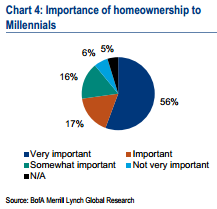
As the housing market prepares to accommodate the next wave of homebuyers, real estate agents should be attuned to the Millennial mindset. Bank of America Merrill Lynch conducted a survey of 1000 adults aged 20-34 across various U.S. cities to determine what Millennials (those born after 1980 through the mid/late 1990s) want.

  • Home ownership is highly valued. 73% of survey respondents report that owning a home is either very important (56%) or important (17%) to them, signifying that Millennials possess a strong desire to own their own home, even if they do not own one yet.

  • When purchasing a home, Millennials most value 1) price, 2) commute time to work, and 3) home size. The importance placed on other factors vary across demographics. For example, married Millennials value school district over restaurants and entertainment whereas the opposite is true for single Millennials. 


  • Millennials prefer the suburbs over the city. 48% of respondents report that they currently live in a suburb and want to live there in the future or live in a city and want to move to a suburb in the future. Contrarily, only 31% of respondents said that they currently live in a city and wish to live in a city in the future or currently live in a suburb but want to move to city. 

  • Millennials are minimally concerned about flexibility. While some may argue that a strong rental market means that people highly value the flexibility to move among cities, the majority (69%)  of survey respondents claimed that it was either not very important or only somewhat important to them. This flexibility is more important to single Millennials than married ones, with 35% and 25% citing flexibility as important or very important, respectively.


January 29, 2015

Home Appraisals (& How To Avoid A Low One!)

A home appraisal is a professional estimate of your home’s value and the land it's on. It reflects the home’s location, size, condition, amenities, and resent sales of nearby, comparable properties (“comps”). Lenders require home appraisals when buyers apply for a mortgage. The appraisal figure determines the loan amount buyers can get to purchase the property. Sellers can get an appraisal before listing their homes, using the Appraiser Institute site. Use this to help set an asking price, and be sure to provide a copy to your buyer’s appraiser.
Lenders hire appraisers, who are third-party, certified and/or licensed contractors. Make sure your lender hires a certified appraiser who works with multiple lenders. You may also request that the appraiser be knowledgable on the area where you live. The buyer typically pays the appraisal fee (a few hundred dollars) upon closing as a part of mortgage costs. An appraisal takes a few hours, and the report is given to the lender in about a week. The lender is required to share the report with the buyer.
Things get more complicated when the appraised value is less than the home’s asking price. Buyers cannot finance the amount that they expected to. Sellers should obtain a copy of the report and make the repairs that they can before requesting a second appraisal. Low appraisals are more common in a poor housing market due to the lack of recent comparable area home sales.

How To Avoid a Low Appraisal

Before the appraisal, spruce up your home the best you can so that its overall condition improves. This includes repairing or replacing soiled carpeting, painting over marks on the walls, mowing the lawn and pulling weeds, and removing peeling paint (since loans insured by the government require peeling paint to be removed in homes before 1978). Fix leaky faucets, cracked windows, missing handrails and structural damage. Focus on updates that will earn a high ROI: paint, carpet, light and plumbing fixtures. You want the home’s effective age—the age an appraiser can assign to a home after considering its updates and condition—to be as low as possible. This affects what homes yours will be compared to. Finally, put any pets away before the appraiser arrives and make sure your home is clean and comfortable enough for the appraiser to do his/her work.
Inform your appraiser of recent short sales or foreclosures that may affect the comps. Let the appraiser know if a nearby home was sold by owner, since this is likely not reflected in the Multiple Listing Service (MLS) from which appraisers draw their information. Also let the appraiser know of any improvements you’ve made to your home in the last 15 years. Keep a list of each update and its approximate cost (from a new roof or insulation to a bathtub that has been resealed). Additional useful information includes the property's best features and a sketch indicating square footages. If improvements have been made to the area where you live (a new playground or grocery store, for example), or if it has been declared a historic or landmark district, notify your appraiser. Click here for a sample appraisal form

January 21, 2015

2014's Top U.S. Moving Destinations

For the second year in a row, Oregon has been named the top moving destination within the U.S. according to United Van Lines' 38th Annual Movers Survey. As the nation's largest household goods mover, the company tracks state-to-state migration patterns, and reports that 66% of Oregon moves were inbound in 2014 as opposed to outbound. South and North Carolina were close behind, each at 61%. Oregon is popular due to its outdoor recreation, culture, and arts and entertainment scene, among other factors. In fact, CNNMoney cites Portland as one of America's most innovative cities. It notes that Portland built a light rail in 1986 instead of a new highway, and commends the city's sustainability and high percentage of bicycle commuters thanks to a 1973 bicycle plan, urban trails, and short blocks.

This is part of a larger patten in which people are leaving the Northeast (with 1/4th citing retirement as the reason) to southern and western states, where housing costs tend to be lower, the weather is more temperate, and job growth is at or above the national average.

States with at least 55% of moves going into the state are considered "high inbound" (marked in blue), states with at least 55% of moves going out of the state are considered "high outbound" (marked in yellow),  and states with relatively equal inbound and outbound rates are considered "balanced" (marked in gray). The migration map below depicts which states fit into each of the above categories:


States with the highest outbound rates include New Jersey (65%), New York (64%), and Connecticut (57%). New this year, Ohio is on the outbound list, ranking sixth with an outbound rate of 59%. Thinking about moving to or from Central Ohio? Visit my website and contact me to see how I can help. I am a full time Realtor with a lifetime of experience serving sellers and buyers in Ohio. 


January 16, 2015

3 Home Buying Myths


1. Buying is always better than renting.  Even though buying a home has tax advantages and secures consistent monthly payments, home-maintenance can be expensive and time-consuming. Typically, buying is only better than renting if you plan to live in your home for 5-7 years or longer, which is roughly as long as it takes for homeowners to break even. Fannie Mae recently revealed that 23% of renters are postponing their plans to buy, and the main reasons people give for purchasing a home are non-financial (43% cited safety as the primary factor while 33% said school quality). One way to estimate whether it's more beneficial to buy is by calculating if the home costs more than 15% of the annual cost of renting a similar home. If  so, you'll get a better deal renting. Still can't decide which option is best for you? Use the rent vs. buy calculator to help or contact me for personal guidance.


2. Real estate is the best investment. Today, investors earn a higher return on investments in stocks than they do on real estate. Within the past 10 years, home prices have risen by only 0.3% annually whereas the S&P 500 has returned an average of 8.26%.  Financial writer Jack Hough cites that over the long run, stocks have rewarded investors with 7% inflation-adjusted return over long periods, while homes earned their owners close to 0%. This is partially explained by the fact that homes don't produce anything. Unless homeowners take measures to actively upgrade their homes, they can only increase in value as the ability of the people to purchase them rises. Appropriately, another Fannie Mae survey illustrated that the proportion of people who believe that buying a home is one of the safest available investments decreased from 83% in 2007 to 70% in 2014. Ironically, only 17% considered stocks safe at that time.

3. The bigger the down payment, the better. Putting down a 20% down payment means you won't have to buy mortgage insurance and you ultimately will borrow less (thus paying less in interest). However, it is not always necessary. You can pay a smaller down payment in exchange for buying PMI (private mortgage insurance) until you have enough home equity (usually 20%) to remove it. Increasingly popular FHA loans accept down payments as low as 3.5%. Smaller down payments (with mortgage insurance) may actually gain you better interest rates than a 20% down payment without insurance, since lenders feel safer when loans are insured. Additionally, saving for a large down payment takes time-home prices may rise in the meantime, or you could miss the opportunity to buy a home you truly love. Smaller down payments ensure all off your money is not tied up in home equity, allows you to diversify your investments (for example, across stocks), and still permits you to pay off the loan early and quit paying mortgage insurance once you put 20% down.

January 7, 2015

Guide to Renting Your Home

Rental property can be lucrative, although proper steps need to be taken to ensure landlord success.
  • Physically Prepare the Rental. This involves inspecting and cleaning the home. Make sure everything is working and in good condition. Fix any problems (a leaky facet, broken smoke detector, or burnt out light bulb) and clean everything--from the floors and windows to the inside of the oven. Care for the lawn and seal cracks in the driveway. If furnishing the home, check to see if the home is properly equipped (for example, see if the kitchen has enough plates, bowls, and silverware), and buy any items that the home lacks.  Remove your most valuable items. If you are storing anything in the home, put it behind locked doors. You can also use zip ties to secure cabinets. Finally, if you have bold, colorful walls, repaint them to a more neutral color such as beige.
  • Decide How to Manage the Rental. Are you going to manage the property yourself, or hire a company to manage it for you? If you manage it yourself, secure a legal lease document for you and your tenant(s). See RocketLawyer's sample lease agreement. Hiring a company reduces your profit because property management companies typically take 4-12% of the monthly rent for their services. On the bright side, the services such companies provide are extensive. They will screen tenant applications, preform repairs, collect rent, deal with IRS payments, and handle evictions as needed. Find a property manager in your area here
  • Notify Your Mortgage and Insurance Companies. Let these companies know that you won't be living in this home. Note that you may be required to meet certain mortgage-as-landlord requirements. Mortgage companies have certain rights to your home to protect its security interests. Switching your homeowner's insurance policy to a landlord policy compensates for losses resulting from tenant negligence, natural disasters, and fire or water damage. 
  • Notify the Post Office. Let them know to divert mail from current or previous owners.
  • Set Your Price and Terms. This depends on your expenses, demand, the market price for comparable rentals, and the details of your property (does it come furnished?). You also must set your policies, addressing pets, smoking, security deposits, included expenses, rent due date, cleaning fees if applicable, and so forth. These should be spelled out in the lease agreement.
  • Review Tenant Applications. RentalsOnline.com states that March-August are the best times to find a tenant. Ask potential renters of their employment and rental histories, in addition to recommendations from previous landlords. You can even ask tenants their Social Security number and written authorization to check their credit reports and criminal history.  
All in all, renting your home is something that takes consideration and time. Completing all the steps before listing your rental home will help ensure both tenant and landlord satisfaction.