Moving Expenses. Moving is time consuming, exhausting work, which is reflected in the cost of packing, moving and storage services. The average move of household goods in 2012 cost $12,459, according to Worldwide ERC. Naturally, costs vary based on a number of factors. The primary factor that movers consider is distance. Other variables affecting price include the size of the home and the weight of the contents of the home. Make sure that the movers inspect your home prior to moving day and provide you with a weight estimate of your belongings. Calculate an estimate of your moving fees, here.
Showing posts with label buying a home. Show all posts
February 18, 2015
What it Costs to Move
When buying a home, it's easy to get caught up on a home's listing price and overlook some of the smaller expenses, such as closing costs and moving fees. Unfortunately, these charges can add up.
Moving Expenses. Moving is time consuming, exhausting work, which is reflected in the cost of packing, moving and storage services. The average move of household goods in 2012 cost $12,459, according to Worldwide ERC. Naturally, costs vary based on a number of factors. The primary factor that movers consider is distance. Other variables affecting price include the size of the home and the weight of the contents of the home. Make sure that the movers inspect your home prior to moving day and provide you with a weight estimate of your belongings. Calculate an estimate of your moving fees, here.
How to minimize moving expenses: The best way to keep moving costs low is to do as much of the packing and moving yourself. If you don't have access to a truck, consider renting a moving truck. U-Haul has trucks of all difference sizes that you can rent from one location and return at another. For a small extra fee, you can also rent protective mats to put furniture on. It's best to schedule ahead of time to ensure that the truck you need is available. If you are moving for work, you can request that your company cover relocation expenses, ideally before you accept the position or plans are finalized.
Moving Expenses. Moving is time consuming, exhausting work, which is reflected in the cost of packing, moving and storage services. The average move of household goods in 2012 cost $12,459, according to Worldwide ERC. Naturally, costs vary based on a number of factors. The primary factor that movers consider is distance. Other variables affecting price include the size of the home and the weight of the contents of the home. Make sure that the movers inspect your home prior to moving day and provide you with a weight estimate of your belongings. Calculate an estimate of your moving fees, here.
February 11, 2015
What it Costs to Close
Closing costs typically amount to 2-5 percent of the purchase price of the home, to be paid at the time the buyer closes on his or her mortgage. A recent survey reports that the average closing fee amounts to $3,700. While lenders are required by law to provide borrowers with good faith estimates of closing costs within three days of when they apply for a loan, many of the fees factored into this "estimate" can change by up to 10% and thus must not be interpreted as a firm calculation. Closing costs consider expenses such as attorney fees, a fee for running a buyer's credit report, an appraisal fee, a survey fee, title insurance and search fees, and an underwriting fee, among others. Estimate your closing costs and see how closing costs vary by state.
How to reduce closing costs: Although the buyer typically pays the closing fee, some homeowners negotiate this with the seller, who may agree to assume part or all of closing costs on behalf of the buyer. Borrows can also seek a no-closing cost mortgage. With this, a buyer pays no closing costs upfront but will likely be charged a higher interest rate, meaning the buyer is not saving that much money in the end.
At the end of the day, these fees may only be a fraction of the price you are paying for a home, but they still amount to thousands of dollars. Make sure that you plan for such expenses so that your home buying process goes as smoothly as possible!
How to reduce closing costs: Although the buyer typically pays the closing fee, some homeowners negotiate this with the seller, who may agree to assume part or all of closing costs on behalf of the buyer. Borrows can also seek a no-closing cost mortgage. With this, a buyer pays no closing costs upfront but will likely be charged a higher interest rate, meaning the buyer is not saving that much money in the end.
At the end of the day, these fees may only be a fraction of the price you are paying for a home, but they still amount to thousands of dollars. Make sure that you plan for such expenses so that your home buying process goes as smoothly as possible!
February 4, 2015
What Millennials Want / The Millennial Mindset
As the housing market prepares to accommodate the next wave of homebuyers,
real estate agents should be attuned to the Millennial mindset. Bank of
America Merrill Lynch conducted a survey of 1000 adults aged 20-34 across
various U.S. cities to determine what Millennials (those born after 1980
through the mid/late 1990s) want.
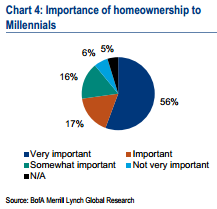
- Home ownership is highly valued. 73% of survey respondents report that owning a home is either very important (56%) or important (17%) to them, signifying that Millennials possess a strong desire to own their own home, even if they do not own one yet.
- When purchasing a home, Millennials most value 1) price, 2) commute time to work, and 3) home size. The importance placed on other factors vary across demographics. For example, married Millennials value school district over restaurants and entertainment whereas the opposite is true for single Millennials.
- Millennials prefer the suburbs over the city. 48% of respondents report that they currently live in a suburb and want to live there in the future or live in a city and want to move to a suburb in the future. Contrarily, only 31% of respondents said that they currently live in a city and wish to live in a city in the future or currently live in a suburb but want to move to city.
- Millennials are minimally concerned about flexibility. While some may argue that a strong rental market means that people highly value the flexibility to move among cities, the majority (69%) of survey respondents claimed that it was either not very important or only somewhat important to them. This flexibility is more important to single Millennials than married ones, with 35% and 25% citing flexibility as important or very important, respectively.
January 29, 2015
Home Appraisals (& How To Avoid A Low One!)
A home appraisal is a professional estimate of your home’s
value and the land it's on. It reflects the home’s location, size, condition,
amenities, and resent sales of nearby, comparable properties (“comps”). Lenders
require home appraisals when buyers apply for a mortgage. The appraisal figure
determines the loan amount buyers can get to purchase the property. Sellers can get an appraisal before listing their homes, using the Appraiser Institute site. Use this to help set an asking price, and be sure to provide a copy to your buyer’s appraiser.
Lenders hire appraisers, who are
third-party, certified and/or licensed contractors. Make sure your lender hires
a certified appraiser who works with multiple lenders. You may also request
that the appraiser be knowledgable on the area where you live. The buyer typically
pays the appraisal fee (a few hundred dollars) upon closing as a part of
mortgage costs. An appraisal takes a few hours, and the report is given to the
lender in about a week. The lender is required to share the report with the buyer.
Things get more complicated when
the appraised value is less than the home’s asking price. Buyers cannot finance
the amount that they expected to. Sellers should obtain a copy of the report
and make the repairs that they can before requesting a second appraisal. Low
appraisals are more common in a poor housing market due to the lack of recent
comparable area home sales.
How To Avoid a Low
Appraisal
Before the appraisal, spruce up
your home the best you can so that its overall condition improves. This
includes repairing or replacing soiled carpeting, painting over marks on the
walls, mowing the lawn and pulling weeds, and removing peeling paint (since
loans insured by the government require peeling paint to be removed in homes
before 1978). Fix leaky faucets, cracked windows, missing handrails and
structural damage. Focus on updates that will earn a high ROI: paint, carpet,
light and plumbing fixtures. You want the home’s effective age—the age an
appraiser can assign to a home after considering its updates and condition—to
be as low as possible. This affects what homes yours will be compared to.
Finally, put any pets away before the appraiser arrives and make sure your home
is clean and comfortable enough for the appraiser to do his/her work.
Inform your appraiser of recent
short sales or foreclosures that may affect the comps. Let the appraiser know
if a nearby home was sold by owner, since this is likely not reflected in the
Multiple Listing Service (MLS) from which appraisers draw their information.
Also let the appraiser know of any improvements you’ve made to your home in the
last 15 years. Keep a list of each update and its approximate cost (from a new
roof or insulation to a bathtub that has been resealed). Additional useful
information includes the property's best features and a sketch indicating
square footages. If improvements have been made to the area where you live (a new
playground or grocery store, for example), or if it has been declared a
historic or landmark district, notify your appraiser. Click here for a sample appraisal form.
December 30, 2014
What Percent of Asking Price Should You Offer?
Most Realtors will tell buyers that the price of a home is negotiable. However, there is no set rule for what percent of a home's asking price to offer the seller. You don't want to overpay, but an offer too low may offend the seller. Your offer price should depend on a number of factors, including:
The appraised value. Whereas asking prices are determined by sellers and their real estate agents, home appraisals are determined by third-party professionals. They can help you determine the true value of a home.
The housing market. If the housing market favors sellers over buyers, you'll need to offer more in order to remain competitive. Paying in cash also increases the competitiveness of offers. This situation is somewhat true of today's housing market, in which limited supply does not meet the high demand. Sales of nearby comparable homes can help you evaluate the market, which varies geographically.
Seller motivation. How eager is the current owner of a home to sell it? Consider a family that has been relocated due to a parent's career. The family has already moved, but its prior home is still on the market. Considering the family is losing money on maintaining the home, and not deriving any benefit, a lower offer stands a better chance than it might for a family that has not yet moved and faces little time pressure.
How long the house has been on the market. This is linked to seller motivation. The longer the house sits on the market, the more work it is for the owners to constantly clean it for showings, consult with their Realtor, etc. Also, sellers who are eager to move will likely grow impatient if buyers do not show interest in their house. Therefore, generally speaking, the longer a home sits on the market, the more likely its owner(s) will be to accept a lower offer.
Overall, many Realtors advise buyers to offer at least 90% of the asking price. However, as noted above, this figure is dependent on many moving parts. In some markets, buyers may even find it necessary to make offers above the asking price. This is one of the reasons that having an experienced Realtor familiar with the area in which you are buying is so crucial. Interested in buying or selling a home in Central Ohio? Contact me to see how I can help!
The appraised value. Whereas asking prices are determined by sellers and their real estate agents, home appraisals are determined by third-party professionals. They can help you determine the true value of a home.
The housing market. If the housing market favors sellers over buyers, you'll need to offer more in order to remain competitive. Paying in cash also increases the competitiveness of offers. This situation is somewhat true of today's housing market, in which limited supply does not meet the high demand. Sales of nearby comparable homes can help you evaluate the market, which varies geographically.
Seller motivation. How eager is the current owner of a home to sell it? Consider a family that has been relocated due to a parent's career. The family has already moved, but its prior home is still on the market. Considering the family is losing money on maintaining the home, and not deriving any benefit, a lower offer stands a better chance than it might for a family that has not yet moved and faces little time pressure.
How long the house has been on the market. This is linked to seller motivation. The longer the house sits on the market, the more work it is for the owners to constantly clean it for showings, consult with their Realtor, etc. Also, sellers who are eager to move will likely grow impatient if buyers do not show interest in their house. Therefore, generally speaking, the longer a home sits on the market, the more likely its owner(s) will be to accept a lower offer.
Overall, many Realtors advise buyers to offer at least 90% of the asking price. However, as noted above, this figure is dependent on many moving parts. In some markets, buyers may even find it necessary to make offers above the asking price. This is one of the reasons that having an experienced Realtor familiar with the area in which you are buying is so crucial. Interested in buying or selling a home in Central Ohio? Contact me to see how I can help!October 20, 2014
Helpful Websites for Prospective Homeowners
The internet is one of your best resources when it comes to buying a home. Websites and mobile apps such as the ones listed below can help you find a realtor, browse homes for sale and rent, see how much you can afford, and check out the crime reports, walkability, and school districts of various communities:
Homes
and Realtors
Realtor.com
– Realtor.com is a great place to start you home search, and can be
accessed from a computer or a mobile device. Realtor.com allows you to input
your own search criteria including price, number of bedrooms/bathrooms,
location, and type of home. Realtor.com also has a search function that generates
a list of nearby open houses, which can be a great way to get a feel for the
current housing market.
Zillow.com
– This has similar features as Realtor.com, but it also allows you to view
information (such as size, year built, and
estimated worth) on homes that are not for sale. This is helpful if you
are curious about the value of other homes in the community you are considering
moving into. You don’t want to have the least or most expensive home in the
neighborhood, as neither is good for resale value. Zillow.com also allows you to shop for mortgage rates and gather home design ideas (which you can pin and
share with other people).
Annualcreditreport.com - A good credit score impacts the interest rate you pay on your
mortgage and how much you can borrow. A score of 692 is average, and the higher your score the better. Federal law allows you to get a free copy of your credit report once a year. Similarly, FreeCreditScore.com offers a free, 7-day trial membership during which you can access your current credit score.
MortgageCalculator.org – Use MortgageCalculator.com to get a rough estimate of monthly payments, pay-off date, and total interest paid. You should also consult with a lender. As a
rough rule of thumb, many lenders advise clients not to spend more than 28% of their monthly, pretax income on a mortgage.
Location
Walkscore.com
– This website is a great resource renters can use to find out how
“walkable” homes are, from a score of 1 (not walkable) to 100 (highly
walkable). Walkschore.com allows you to serach for rentals based on rent,
number of bedrooms, commute time, distance to public transportation, and
walkscore. It also lets you filter your search to include pet-friendly
options. Walkscore tells you what amenities are in walking distance and how far
they are from any given home. Amenities include restaurants, shops, schools,
gyms, etc. The one downside of
this website and mobile app is that it only shows rentals—not homes for sale.
However, homeowners can select a rental nearby in order to look at the area
around it. Buyers can also use GoogleMaps.com.
GoogleMaps doesn’t provide a walk score, but still illustrates what homes are
surrounded by and how close they are to city centers, schools, and so forth.
Crimereports.com – Enter an address or
ZIP code to access statistics on crime. Remember, every community has some
degree of crime. It’s a good idea to talk to current residents of a particular
neighborhood to see how safe they feel.
GreatSchools.com – This website rates
schools, which is important even for people without children. A good school
district helps a home maintain its value other the years. When you eventually sell
your home, the school district may be paramount to buyers even if it was
secondary to you.
Your most trusted resource when searching for a home is a professional real estate agent. Hire an experienced REALTOR who is a good communicator and knows the market well. If you or someone you know is thinking about buying a home in Central Ohio, visit my website and contact me to ask how I can help.
October 16, 2014
Millennials Put Hold on American Dream
Millennials-those born after 1980 through the mid/late 1990s-are
not buying homes at the rate previous generations have. To determine why, Bank
of America Merrill Lynch conducted a survey of 1000 adults ages 20-34 across
various U.S. cities. This is what the company found:
Millennials want to own their own home, but lack the financial
resources to do so. 73% of survey respondents report
that owning a home is either very important (56%) or important (17%) to them,
indicating that Millennials maintain the strong desire to own
their own homes consistent with the classic perception of
the American Dream. However, Millennials have been negatively
affected by cyclical economic factors including high unemployment, lack of wage
growth, and lack of credit.
The study suggests that Millennials may have a distorted image of interest rates as a result of growing up during a time when interest rates were artificially low, hovering around 3-5%. Looking back in time presents a different picture: since 1971, the median 30-year fixed mortgage rate has been 7.98%. Employment for those ages 25-34 is 75.6%, which is more than the low of 73.4 but still behind the pre-recession level of 83%. Wage growth has been slow, with the real median income for those under 35 falling 16% from $42,000 in 2007 to $35,000 in 2013. Tight credit remains another issue. The average qualifying FICO score as of July 2014 (690 and 760 for an FHA mortgage and conventional mortgage, respectively), is nearly 13 points greater than the average score back to 2000.
Student loan debt is also hindering
first-time homebuyers. One
quarter of survey respondents cite that student debt has prohibited them
from purchasing a home to date. The median education debt for
those under 35 was $17,200 in 2013. It is not a surprise, then, that the survey
revealed that Millennials who have student loans are 55% more likely to
currently rent than own a home.
Nineteen percent of Millennials are living
with their parents. This consists of 31% for those ages 20-24,
16% ages 25-29, and 10% ages 30-34. Many Millennials are living in an apartment
(38%) while others have their own home (31%). Not surprising, higher income
earners are much more likely to be living in their own home. 12% of respondents
making less than $25,000 own their own home, while 60% of those making $75,000-$100,000
own their own home.
Millennials are delaying household
formation, including getting married and having
children. Annual household formations of married couples lave dropped 61% for
those under 25, 41% for those 25-29, and 18% for those 30-34 since 1982.
Mellennials are having fewer kids, and they are having them later in life.
Birthrates for women ages 20-29 are decreasing while birthrates for women ages
30-39 are increasing.
As the economy continues to recover and
Millennials increase their earnings, they are expected to enter the housing
market in greater numbers. Half of those surveyed plan to buy a home within the
next five years. The American Dream is not lost: it is merely on hold.
July 3, 2014
How Buyers can Compete Against Investors
Real estate
investors are currently attracted to less expensive cities with little
competition. Specifically, investors are looking for cities where the
medium home price is at or below $195,000. You can find out which cities meet
this criteria at Realtor.com’s Trends page. A foreclosure to for-sale
listings ratio of 1:1 or higher is also a good metric to evaluate potential areas to invest in
property: areas with this ratio or higher are likely to attract investors. This
information can be found on RealtyTrac.com’s Stats & Trends page.
If you’re
interested in buying a foreclosure as a residence and not an investment
property, check out homepath.com
using search terms “Fannie Mae foreclosures.” Buyers have priority
over these listings for 20 days, at which point they become anyone's
game. Buyers can also avoid competition with investors by purchasing new
construction. Investors aren't looking for polished, updated homes; they are
looking for deals--cheaper homes they can renovate and put back on the market
for a much higher price. Of course, seeking a Realtor’s help can be of
great use, given their experience. Some realtors even have “pocket listings”
(those not entered into the MLS) that they share with clients. If you do find
yourself competing with an investor for a property, be prepared to top the
investor’s offer by at least 5%. This makes up for the fact that an investor’s
all-cash offer will be more appealing. Going through underwriting before you
house hunt shows sellers you are motivated. A final tactic is one that appeals
to a seller’s emotions. Write to the seller(s) about why you want their home.
Some people want their homes to be used for raising a family, for example, and
would prefer selling to a family to a company.
Sellers should consider this
point as well. They will likely get a better price for their home if it is sold
as a residence, as buyers often have more incentive to negotiate (they are
willing to fight for their dream home).
However, this process will take longer and cash payment is unusual.
May 21, 2014
To Buy or Sell First?
If you already own a home and are
looking for a new one, you’re faced with a challenging question: should you
sell your current home before you buy your new one, or vice-versa? To help make
this decision, consider the following three factors:
1)
Market conditions. You may have heard terms such as "seller's" or "buyer's" market. However, when you sell and buy homes, you must consider the housing market for your given neighborhood, house style, and price. Work with a professional Realtor to get an idea of how long your home should sit on the market, and about how long it should take you to find what exactly you are looking for. Use online resources such as Realtor.com to see how common homes are that meet your criteria.
2)
Finances. Many people need the equity from selling their current home to
put towards the down payment on their new home. So what do you do while
transitioning? You could stay with friends or family, or temporarily move into
a rental unit (this may require you to rent a storage unit, as well).
Alternatively, you can rent your home from your buyers in order to give you
more time. The rent-back term is only valid for a maximum of 60 days, as a
longer lease would categorize the home as income property. Lenders may be able
to help you by granting you a bridge loan. The drawback to selling your home
before you buy another is that you may feel rushed if you are unable to find a
home you like in a reasonable amount of time.
3)
Risk Aversion. Would you rather be stuck with nowhere to live, or with two
mortgages? Regardless, Realtor.com advises homeowners to have a backup plan—for example, an alternative source of income or a place to stay should you sell your home sooner than expected.
March 11, 2014
The Inside Scoop on Rent-to-Own Agreements

What is a rent-to-own agreement?
- A rent-to-own agreement is a contract between a property owner and a renter in which a renter agrees to rent the property for a predetermined amount of time, usually 1-3 years. The renter pays an above-market rate and allocates excess rent towards a down payment. At the end of this time period, the renter purchases the home at the price stated in the contract.
Who do they benefit?
- Rent-to-own leases can benefit both homeowners and renters. They are great for sellers who are eager to move out but have yet to sell their home. Similarly, they benefit renters who are equally as eager to buy a home but lack financial preparedness. For example, renters may need additional time to save for a down-payment, improve their credit score, or pay off debt. Rent-to-own agreements allow renters to secure and settle into the home they want before having to actually but it.
When is it a bad idea?
- Renters who are not positive they want to remain in their rental should be wary of rent-to-own agreements. Because renters pay above-market rent in such contracts, it may be more practical to simply rent a home rather than sign a rent-to-own agreement. This is less expensive and offers the renter more flexibility when looking for a home after their lease is up.
What should rent-to-own agreements include?
- An attorney should be hired to draft a rent-to-own agreement. It's also advisable to consult a lender. Generally speaking, a rent-to-own lease should specify the following information:
- Length of the lease period.
- Rental rate.
- Rent credit for down payment and how it will be held until the time of purchase.
- Who will pay for maintainance, repairs, utilities, property taxes, insurance, and homeowner fees during the lease period.
- When the title is transferred to the renter.
- What happens if home values rise or fall between the time the contract is signed and the time of purchase.
- Who is responsible if something happens to the property during the rental period.
Finally, I recommend that renters have a home inspection before buying any property, even if they have been living in it. Interested in renting or buying a home? Contact me.
Subscribe to:
Posts (Atom)